History and the Future
Historical Background
 |
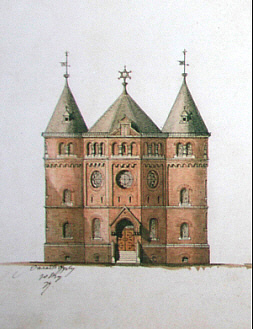 Historic Synagogue, circa 1879 |
The Jewish population was expelled several times during the 14th through 16th centuries, but some families were allowed to return for economic reasons. By 1877, the Jewish community had grown to approximately 200 individuals. The congregation bought land on the Buerenstrasse where a large synagogue was built by architect Edwin Oppler in 1879. By World War II, several families left for larger cities, leaving the community with 153 members.
During the November 1938 pogrom known as Kristallnacht, the synagogue was destroyed by fire. Members of the community were deported, and a total of 101 members were murdered during the Holocaust. None of the surviving members of the community returned.
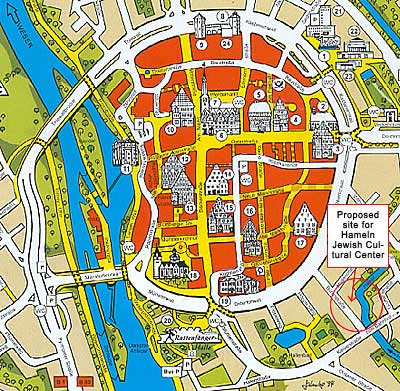 The new Jewish Cultural Center site is located outside the center of Hamelin on the river. |
|
| |
The New Community
A new community began forming in the 1990s after the German government invited Jewish families living in the Former Soviet Union to immigrate to Germany to towns once settled by Jews. In 1997, Rachel Dohme founded the Reform Jewish Community of Hamelin (Jüdische Gemeinde Hameln, JGH) with only seventeen Russian émigrés. Today the first Jewish community in Hamelin since World War II has grown to over 200 members and is still growing.
JGH is served by Rabbi Dr. Ulrike Offenberg. The congregation offers religious and social services—adult education, a religious school, and participation in summer camp.
In November 2001 the community bought the land on the Buerenstrasse where Edwin Oppler’s synagogue once stood (Synagoge Platz 1). The first newly constructed Reform synagogue in post-war Germany was designed by Frank Taylor. The building has been constructed by the Architectural Team of Peter Nasarek.
|
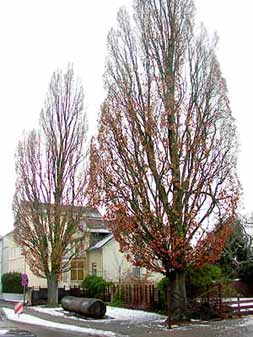 “Synagoge Platz 1” (1 Synagogue Place), building site for the Hamelin Jewish Cultural Center |
The New Hamelin Cultural Center
The new Hamelin Jewish Cultural Center is constructed of brick and concrete/stucco and includes a sanctuary with approximately 100 movable seats to allow the space to serve multiple functions. The center includes an integration office, a library, and several classrooms.
The point of entry into the synagogue is on the side of the new oval structure. Ten slim rectangular windows, visible from the sanctuary, grace the eastern wall of the synagogue, symbolic of the Ten Commandments. The Aron ha Kodesh (Ark) has been handmade from Eurpoean maple. The Parochet (Ark curtain), featuring a tree of life, was created by textile artist Jane Hewison. The Ner Tamid (Eternal Light) depicts the tree of life in the four seasons of the year, symbolizing continuity. It was created by glass artist Ruth Schweining.The Holocaust memorial remains in place in front of the synagogue.